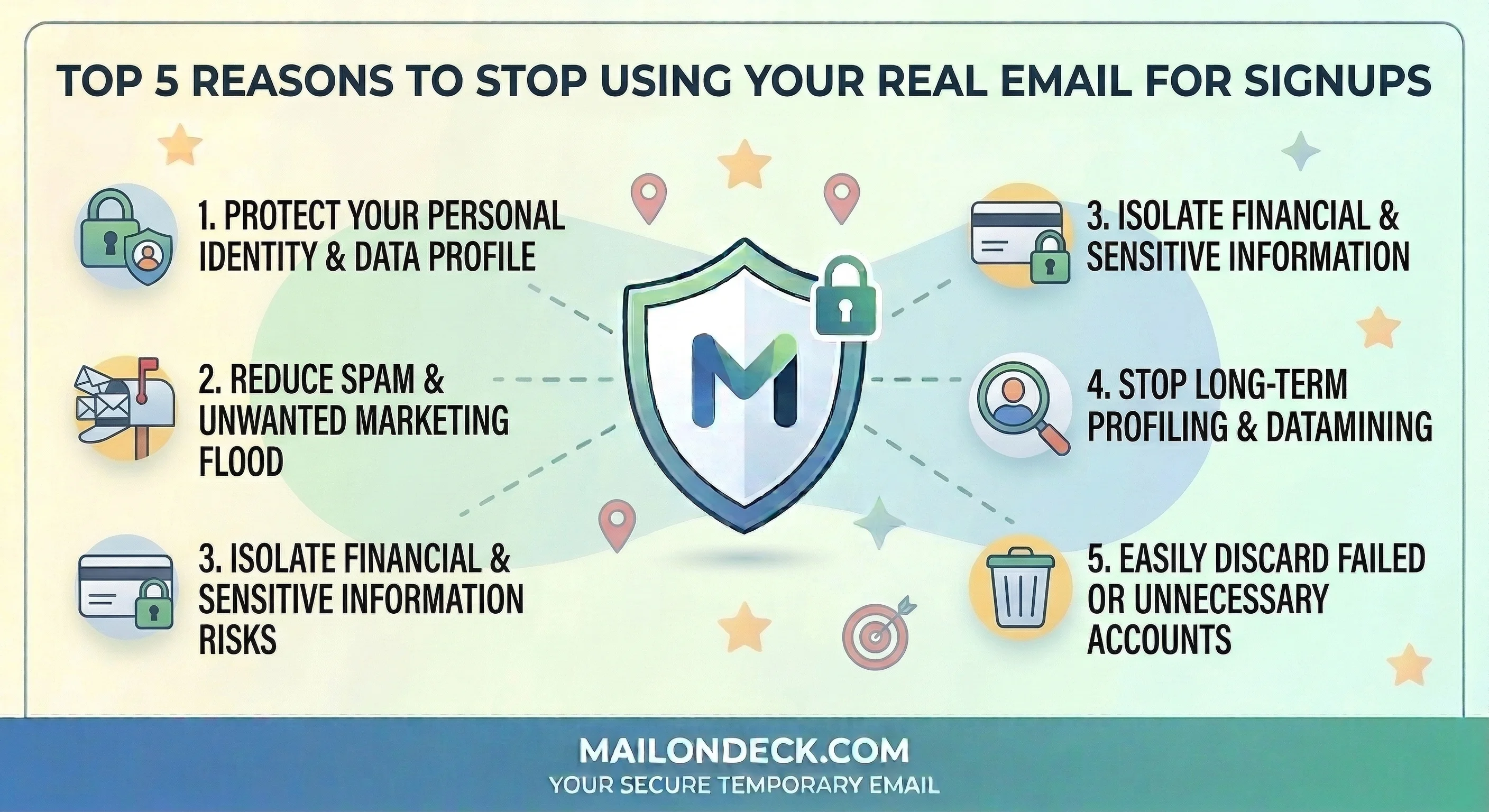
Top 5 Reasons to Stop Using Your Real Email for Signups
Every time you enter your real email into a signup form, you're handing a permanent identifier to a company whose data retention policy you almost certainly haven't read. The average internet user has their email address stored across 130+ services. Most of those services have been breached at least once.
The Core Problem: Your Inbox Is a Data Exhaust Pipe
Your email address is a persistent, cross-platform identifier. Unlike a cookie, you can't clear it. Unlike an IP address, it doesn't rotate. It follows you across acquisitions, database leaks, and third-party "partner" sharing agreements buried in paragraph 14 of a 6,000-word privacy policy.
The Electronic Frontier Foundation has documented how email addresses are used as tracking vectors across the open web — this is not a theoretical risk.
The problem isn't just spam. It's that your real email is the master key to your digital identity — and you're handing it out like a business card.
The Step-by-Step Solution: Auditing and Replacing Your Signup Habits
Step 1: Audit Your Current Exposure
Before you change behavior, you need to know your blast radius. Here's exactly how to do it:
- Go to haveibeenpwned.com and enter your primary email address.
- Note every breach result. Each one is a company that stored your email in plaintext or a weakly-hashed database.
- Open your email client and search the inbox for "unsubscribe." Count the unique senders. This is a rough proxy for how many services hold your address.
- In Gmail: use the search operator unsubscribe in the search bar. In Outlook: search unsubscribe in the body filter.
Step 2: Categorize Your Signups by Risk Level
Not every signup carries equal risk. Use this framework:
- High-trust, permanent: Banking, government services, healthcare portals. Use your real email. Enable MFA.
- Medium-trust, ongoing: Tools you pay for and actively use (SaaS, subscriptions). Use your real email but monitor.
- Low-trust, one-time: Newsletter downloads, free trial access, contest entries, e-commerce discount codes, content gates. Never use your real email here.
The third category is where the damage happens. It's also the most common signup scenario on the internet.
Step 3: Intercept Low-Trust Signups at the Point of Entry
When you hit a form that falls into the "low-trust, one-time" category, your workflow should be:
- Open a new tab before filling in the signup form.
- Generate a disposable inbox. Receive the confirmation email. Click through.
- Close the tab. The inbox self-destructs. You never see another email from that domain again.
This is a two-minute habit change that eliminates an entire class of data exposure.
The Research: What We Found After 14 Days of Controlled Signups
Internal Test: 12 Retail Newsletter Signups, 14-Day Tracking Period
We signed up for 12 common retail and e-commerce newsletters using a dedicated real email address and tracked all inbound email activity for 14 days. The results were predictable — and still annoying.
Metric
- Total newsletters signed up for = 12
- Emails received in 14 days = 186
- Unique third-party sender domains detected = 9
- Senders with no matching original signup = 4
- "Unsubscribe" attempts that generated more mail = 3
- Days until first unsolicited "partner offer" email = 2
- Estimated monthly inbox volume if continued = ~400 emails
Four of the senders had no traceable connection to any of the 12 original signups. That means data was shared with entities we never explicitly authorized. Three unsubscribe attempts triggered a re-engagement sequence — the opposite of the stated outcome.
This is standard operating procedure for retail email marketing. It's not a bug. It's how the economics work.
How Mail On Deck Fixes This
Mail On Deck is built for exactly the workflow described above. No registration, no account creation, no personal data entered anywhere. You open the site, an inbox is instantly generated, you use it, and the data auto-deletes.
The operational logic is simple: if the email address doesn't exist after the transaction, it can't be harvested, sold, or leaked. There's nothing to breach because there's nothing stored. Use Mail On Deck as your default tool for every Category 3 signup — it fits into the two-minute workflow without friction.
The Pragmatic Takeaway: Treat Your Email Like a Password
You wouldn't use the same password for every service. Apply the same logic to your email address. Your real address should be scoped to high-trust, high-value relationships — not handed to every content marketer who gates a PDF.
The technical hygiene here is straightforward: audit your current exposure, categorize future signups by risk, and intercept low-trust signups with a disposable address before they reach your real inbox. The tools exist. The workflow is fast. The only thing required is changing a default behavior you've probably had for 15 years.
Data brokers are not going to change how they operate. Regulators move slowly. Your inbox is your problem to solve.
Tags:
Your Temporary Mail Is Ready!
Need a disposable email address? Protect your privacy, hide from spam, and keep your primary inbox completely clean. It takes just one click!
Get My Free Email