Think about how many times you have typed your email address into a website form this week. Maybe you wanted to download a template. Perhaps you needed to access free WiFi. Or you were just browsing and a popup appeared, promising a discount if you subscribed to their newsletter.
Each time you entered that email address, you probably did not think much about it. It feels harmless. After all, what is the worst that could happen? You might get a few promotional emails. Maybe you will need to unsubscribe from some lists. Not a big deal, right?
This casual attitude toward sharing email addresses has become so normalized that most people do not even pause before typing their primary email into yet another signup form. But here is the uncomfortable truth: every time you give out your real email address, you are making a small sacrifice of your privacy, security, and peace of mind.
The consequences might not be immediate. You might not notice anything wrong for weeks or even months. But slowly, inevitably, the problems accumulate. Your inbox fills with messages you never asked for. Your email address appears in databases you did not know existed. Companies you have never heard of somehow know your email and feel entitled to contact you.
This article will show you exactly what happens when you use your real email for online signups, why it matters more than you might think, and what you can do differently.
When you provide your email address to a website, you are not just giving them a way to contact you. You are providing them with a valuable piece of personal data that has real monetary worth in the digital economy.
Your email address serves as a unique identifier that can be used to track your behavior across multiple websites and platforms. It connects your various online activities into a single profile. That PDF you downloaded from one site, the newsletter you subscribed to on another, the account you created on a third platform—all of these can be linked together through your email address.
This creates a detailed picture of your interests, habits, and behavior. Marketing companies pay good money for this information because it helps them target you more effectively. The more they know about you, the better they can craft messages designed to make you buy things.
But the cost goes beyond just receiving targeted advertising. Your email address often becomes the entry point for more invasive data collection. Once a company has your email, they can use it to find your social media profiles, match it with data from other sources, and build an even more comprehensive profile about who you are.
There is also the simple matter of attention. Every promotional email, every newsletter, every marketing message is demanding a small piece of your focus. Over time, these add up. The mental burden of managing an inbox flooded with unwanted messages might seem trivial, but it represents a genuine tax on your time and energy.
Then there is the security angle. Your email address is often used as your username for various accounts. When that email appears in a data breach—and statistically, it probably will at some point—it gives attackers a starting point for trying to compromise your accounts. They know at least one piece of information about you, and they can use it to attempt password resets, phishing attacks, or other forms of social engineering.
The cost of casually handing out your email address is not paid all at once. It accrues slowly, in small increments, until one day you realize your inbox has become unmanageable and your digital privacy has been compromised in ways you never intended.
Most people imagine that when they provide their email to a website, it goes into that company's database and stays there. The company might send you some emails, and that is the extent of it. Unfortunately, the reality is much more complex and considerably less reassuring.
The journey of your email address after signup often follows a predictable pattern, though most companies will not tell you about it explicitly. First, your address goes into their customer relationship management system. This is expected and reasonable. You provided it for a purpose, and they need to store it to fulfill that purpose.
But then the sharing begins. Many companies have partnerships with other businesses in related industries. They might share customer email lists with these partners, sometimes with your implicit consent buried in terms of service you did not read, sometimes without asking at all. Your email address begins spreading to companies you never directly interacted with.
Some companies sell their email lists outright. They might dress it up in more palatable language—licensing their database, engaging in co-marketing arrangements, providing leads to affiliated partners—but the result is the same. Your email address gets sold to third parties who now feel entitled to contact you because they technically obtained your information through legal means.
Then there is the data broker ecosystem. Specialized companies exist solely to collect, aggregate, and sell personal information, including email addresses. They compile data from hundreds or thousands of sources, creating comprehensive profiles that include your email along with other personal details. These profiles get sold to marketers, researchers, and anyone else willing to pay.
The verification emails you receive are not just confirming your signup. They are also confirming that your email address is active and that you actually check it. This information is valuable. An email address that has been verified as active is worth more to marketers than one that might be abandoned or fake.
Some companies append your email to tracking pixels and cookies, allowing them to follow you around the internet. When you visit other websites that use the same advertising networks or tracking services, your email address helps connect your browsing behavior across different sites.
If the company you signed up with gets acquired by another business, your email address transfers to the new owner. You never agreed to give the new company your information, but they have it anyway because they bought the database along with everything else.
And if the company experiences a data breach—which happens disturbingly often—your email address might end up in the hands of criminals who will use it for spam, phishing attempts, or as part of larger identity theft schemes.
All of this happens in the background, invisible to you, set in motion by a single seemingly innocent act of typing your email into a form.
The digital marketing industry is built on personal data, and email addresses are one of its most valuable currencies. Understanding how companies profit from your email helps illustrate why they are so eager to collect it.
The most direct profit comes from email marketing itself. Studies consistently show that email marketing delivers one of the highest returns on investment of any marketing channel. For every dollar spent on email marketing, companies see an average return of thirty to forty dollars. Those promotional emails cluttering your inbox exist because they work. People buy things when marketed to via email.
But the value extends well beyond the company's own marketing efforts. Email lists are regularly rented or sold to other businesses. A company might charge anywhere from a few cents to several dollars per email address, depending on how targeted and verified the list is. If they have a hundred thousand email addresses, that represents substantial revenue just from licensing the list to others.
Data enrichment services pay for email addresses because they can use them to find additional information about you. Your email can be cross-referenced against social media profiles, public records, purchase histories, and other databases to create a more complete picture of who you are. This enriched data is then sold at a premium.
Advertising networks use email addresses as matching keys. When you provide your email to one website that uses a particular ad network, that network can now recognize you across all the other websites in their network. This enables retargeting—showing you ads based on your behavior on entirely different websites. The ability to track users across sites is enormously valuable to advertisers.
Some companies use email lists to build lookalike audiences. They provide your email address to advertising platforms, which then find other people who share similar characteristics and behaviors. Your email helps companies find and market to people like you, even though those people never directly interacted with the company.
Email addresses also help companies improve their targeting algorithms. The more data they have about who responds to what messages, the better they get at predicting what will work. Your email address, combined with your behavior, becomes training data that makes future marketing more effective.
For subscription-based businesses, your email is the hook that keeps you engaged. They send you regular reminders, updates, and promotions designed to prevent you from canceling or forgetting about them. The lifetime value of a customer is much higher if they stay subscribed for years rather than months, and email is the primary tool for maintaining that relationship.
Analytics and research firms pay for access to email-based data because it helps them understand market trends, consumer behavior, and industry patterns. Your individual email might not be worth much, but aggregated with millions of others, it creates valuable insights that companies will pay for.
The profit motive is why websites are so aggressive about collecting email addresses. They are not just trying to stay in touch with you out of friendliness. Your email represents real money, either directly through their own marketing or indirectly through all the various ways they can monetize that data.
Data breaches have become so common that they barely make headlines anymore unless they are truly massive. But the frequency with which companies lose control of customer data should concern anyone who regularly hands out their email address.
Every time you provide your email to a company, you are trusting them to protect it. You are trusting their security practices, their employee training, their software updates, and their vigilance against hackers. That is a lot of trust to place in companies you might know nothing about.
The unfortunate reality is that many companies, especially smaller ones, do not invest adequately in security. They might store email addresses in unencrypted databases. They might use outdated software with known vulnerabilities. They might have poor password policies for their own employees. They might lack basic security measures that would prevent unauthorized access.
When a breach occurs, the consequences extend far beyond that single company. Your email address, once compromised, often ends up in dumps that circulate among criminals. It gets added to spam lists. It gets used in phishing campaigns. It becomes part of credential stuffing attacks where hackers try your email combined with common passwords against thousands of different websites.
Even if you use different passwords for every site—which you should—the fact that your email is known makes you a target. Hackers can send you convincing phishing emails pretending to be from services you actually use. They can attempt social engineering attacks. They can try to reset your passwords on various platforms.
The scale of the problem is staggering. Billions of email addresses have been exposed in data breaches over the past decade. Chances are good that your email address has appeared in at least one breach, possibly many. You can check sites like Have I Been Pwned to see which breaches have included your email, but even that only shows the breaches that have been publicly disclosed. Many breaches never become public knowledge.
Some companies do not even realize they have been breached until months or years later. During that time, criminals have access to your email address and whatever other information was in the database. By the time you receive a notification—if you receive one at all—the damage has already been done.
The worst part is that you have no control over it. You can do everything right on your end—use strong passwords, enable two-factor authentication, be careful about phishing—but if a company you trusted with your email fails to protect it adequately, you still suffer the consequences.
This is why minimizing where your real email address exists is important. Every additional company that has your email is another potential point of failure, another database that might get breached, another link in a chain that is only as strong as its weakest point.
When most people think about the downsides of sharing their email freely, spam is the first thing that comes to mind. And yes, spam is annoying. But it is actually one of the less serious consequences of promiscuous email sharing.
Spam clogs your inbox and wastes your time, but modern email filters have gotten fairly good at catching obvious spam. The messages that make it through are usually just annoying rather than dangerous. You delete them and move on.
More concerning is the phishing email that looks legitimate. These messages appear to come from companies you actually do business with. They use logos and formatting that match the real company. They create a sense of urgency—your account will be locked, a package cannot be delivered, a payment has failed—and include a link for you to "fix" the problem.
When your email address is widely distributed, it becomes easier for scammers to craft convincing phishing attempts. They do not need to guess whether you have an account with a particular service. They can simply send phishing emails for dozens of popular services, knowing that statistically, you probably use at least some of them.
Then there is the problem of email overload, which goes beyond simple spam. When you sign up for dozens or hundreds of services with your real email, you start receiving legitimate messages from all of them. Newsletters you forgot you subscribed to. Account notifications from platforms you no longer use. Updates about services you tried once and never touched again.
This creates a signal-to-noise problem. Important emails get buried in a flood of less important ones. You might miss a critical message from your bank because it arrived alongside twenty promotional emails. The more your real email is spread around, the harder it becomes to use that email effectively for things that actually matter.
Some companies engage in dark patterns with email. They make it easy to subscribe but difficult to unsubscribe. They might require you to log in to change email preferences. They might have multiple different lists you need to unsubscribe from separately. They might take weeks to actually remove you from their lists, during which time messages keep coming.
There is also the issue of email forwarding and sharing within corporate structures. When you give your email to one brand, it might be shared across their entire family of companies. If that parent corporation owns twenty different brands, you might start receiving emails from all twenty, even though you only signed up for one.
As AI and automation improve, the sophistication of unwanted email increases. Messages become more personalized, more convincing, and harder to distinguish from legitimate communication. When your email is widely distributed, you become a target for these increasingly sophisticated campaigns.
The fundamental problem is that email was designed for communication, not as a universal identifier for every online interaction. We have stretched it far beyond its intended purpose, and the result is a degraded experience that forces people to spend significant time and energy managing their inbox rather than using email for actual communication.
Your email address enables tracking in ways that might not be immediately obvious. Companies have developed sophisticated methods for using email to monitor your behavior, both within their own platforms and across the broader internet.
Email tracking pixels are tiny, invisible images embedded in emails. When you open an email, your email client loads these images, which tells the sender that you opened the message. This information alone is valuable—it confirms your email is active and that you engage with messages from this sender.
But tracking goes deeper. Some pixels include unique identifiers that can track not just that you opened the email, but when you opened it, how many times you opened it, what device you used, and even your approximate location based on your IP address. All of this from simply opening what looks like a normal email.
Link tracking is another common technique. When an email includes a link, it is often not a direct link to the destination. Instead, it routes through a tracking server that logs the click before redirecting you to the actual page. This tells the company which links you click, which content interests you, and when you are most likely to engage.
Some email platforms can tell if you forwarded an email to someone else. They know if you filed it away in a folder versus deleting it immediately. They can measure how long you spent reading the message. All of this behavioral data feeds into profiles used for marketing and targeting.
When you use your real email across multiple platforms, these tracking systems can connect your activity. Even if you do not explicitly link your accounts, the email address serves as a common thread. Companies can purchase data from multiple sources and merge it together based on email addresses, creating a comprehensive view of your online behavior.
Advertising platforms take this even further. They can match your email address to your social media profiles, your browsing history, your purchases, and your app usage. This creates what the industry calls a "360-degree view" of you as a consumer. Every piece of data linked to your email helps complete this picture.
The tracking extends offline too. When you use your email to sign up for a loyalty card at a physical store, your in-store purchases get connected to your online profile. Retailers can now see not just what you bought in their store, but also what you browsed on their website, what emails you opened, and what ads you clicked.
Some sophisticated tracking systems can even work across devices. If you open an email on your phone and later visit a website on your laptop, the company might be able to connect those two activities because both are associated with your email address, even if you never explicitly logged into anything on the laptop.
Email-based tracking is particularly insidious because it happens passively. You do not need to take any action beyond opening an email or clicking a link—things that feel perfectly normal and harmless. Meanwhile, data is being collected and added to your profile without your active knowledge or consent.
Privacy-conscious users might use browser extensions to block tracking on websites, but email tracking happens in your email client, which typically has fewer protections. The tracking occurs before you even realize there is something to block.
Many people feel more comfortable providing their email when they see that a website looks professional, has security badges, or requires email verification. The thinking is that legitimate businesses with verification systems must be trustworthy. Unfortunately, requiring email verification says almost nothing about how that email will be used or protected.
Email verification proves only one thing: that the company wants to confirm you control the email address you provided. This makes sense from their perspective. They want to avoid fake signups and ensure they can actually reach you. But verification does not mean they will respect your privacy or use your email responsibly.
A company can have a perfectly functional verification system while simultaneously selling your email to data brokers, spamming you daily, or failing to secure their database properly. The verification process and their data practices are completely separate things.
In fact, verification can sometimes make things worse for your privacy. By clicking that verification link, you confirm not just that the email address is valid, but that you are actively using it and checking it. This makes your email more valuable to marketers. Verified, active email addresses sell for higher prices than unverified ones.
Some companies use verification as an opportunity to set tracking cookies or collect additional information about you. When you click the verification link, you visit their website, which might install trackers, fingerprint your browser, or note your IP address and device information.
Professional-looking websites with security badges can be just as problematic as sketchy-looking ones, sometimes more so. A polished appearance might make you feel safe, but it tells you nothing about their privacy practices. Some of the worst offenders in terms of email sharing and spam come from companies with beautiful websites and seemingly legitimate operations.
HTTPS encryption and security certificates only mean that the connection between your browser and their server is encrypted. This is good for preventing eavesdropping, but it does not prevent the company itself from misusing your email. You are transmitting your email securely to them, but what they do with it afterward is a completely separate question.
Privacy policies and terms of service technically disclose how companies will use your email, but they are written in dense legal language that few people read or understand. Even when you do read them, they often include broad permissions that allow the company to do almost anything with your data while technically having disclosed it.
The presence of an unsubscribe link in emails is often cited as a sign of legitimacy. While it is better than having no unsubscribe option, it does not protect you from all the other ways your email might be used. Unsubscribing stops future marketing emails from that sender, but it does not remove your email from their database, prevent them from sharing it with partners, or protect you if they experience a data breach.
Established brands and recognizable companies are not automatically safer with your email either. Large corporations have been involved in major data breaches, aggressive email sharing practices, and privacy violations. Name recognition does not equal trustworthiness when it comes to data handling.
The only way to truly know how a company will use your email is to research their specific practices, read their privacy policy carefully, and look for reports of how they have handled customer data in the past. For most casual interactions—downloading a file, accessing a one-time resource, getting a discount code—that level of research is not worth the effort. Using a temporary email is simpler and safer.
Given all these problems with using your real email for online signups, what is the alternative? For most casual online interactions, the answer is temporary email addresses.
A temporary email address, also called disposable email or temp mail, is designed specifically for situations where you need an email but do not want the long-term consequences. Services like Mail On Deck generate these addresses instantly, with no registration or personal information required.
The concept is straightforward. You get a working email address that can receive messages, just like your regular email. The difference is that it only exists temporarily—usually for a set number of hours. After that period, the address stops working and all messages are permanently deleted.
This approach solves most of the problems we have discussed. When you use a temporary email for signups, your real email never enters that company's database. They cannot sell it, share it, lose it in a breach, or use it to track you. Even if they try to spam the address, those messages go nowhere because the address no longer exists.
Temporary email is perfect for one-time interactions. Downloading a template? Use temp mail. Accessing gated content? Temp mail. Getting a discount code? Temp mail. Signing up for a free trial you probably will not continue? Temp mail. Any situation where you need an email to unlock something but do not need ongoing communication is an ideal use case.
It also works well when you are uncertain about a website's legitimacy. If you are not sure whether to trust a company, using a temporary email protects you from the consequences of being wrong. If they turn out to be trustworthy and you want to continue the relationship, you can always provide your real email later.
For developers and testers, temporary email is invaluable. Testing registration flows, verification systems, and email functionality requires many email addresses. Generating disposable addresses is far more efficient than creating and managing multiple real email accounts.
The privacy benefits extend beyond just avoiding spam. Using temporary email breaks the tracking connections that companies build across the internet. Without your real email tying together your various activities, it becomes much harder to build a comprehensive profile of your online behavior.
Temporary email also reduces your attack surface for security threats. Every company that has your real email represents a potential entry point for hackers. By minimizing where your real email exists, you reduce the number of places that could leak it in a breach.
The important caveat is that temporary email is not appropriate for everything. You should not use it for important accounts, financial services, healthcare, government interactions, or anything where losing access would create problems. Your real email still has its place—you are just being more selective about where you use it.
Services like Mail On Deck make using temporary email effortless. Visit the website, and an email address is already generated and waiting for you. Copy it, use it wherever needed, and either manually delete it when finished or just walk away and let it expire automatically. No account to manage, no settings to configure, no complexity.
By shifting your default behavior from "use my real email" to "use temp mail unless there is a specific reason not to," you can dramatically reduce your exposure to spam, tracking, data breaches, and privacy violations. You still have access to all the same content and services, but without paying the price with your privacy and inbox sanity.
Understanding the theory behind email privacy concerns is one thing. Seeing concrete examples of how companies misuse email addresses makes the issue much more tangible.
Consider the case of a popular website that offers free design templates. They require an email to download. Seems reasonable—they are providing value and just want a way to stay in touch. You provide your email, download the template, and move on. Within days, you start receiving emails from their "partners." Within weeks, you are getting messages from companies you have never heard of. It turns out the template site sells its email list to anyone who will pay, and they disclosed this in paragraph seventeen of their privacy policy that you did not read.
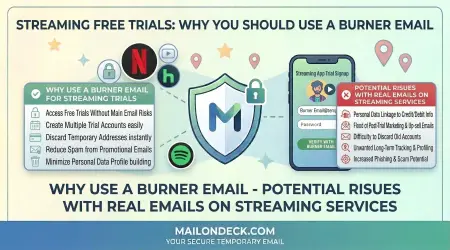
Or take the free trial scenario. You sign up for a streaming service's free trial using your real email. The service is fine, but you decide not to continue after the trial ends. For the next year, you receive emails multiple times per week trying to get you back. "We miss you." "Special offer just for you." "Your favorite shows are waiting." They make unsubscribing difficult, requiring you to log into your old account to change email preferences. Some of their emails come from different sending addresses, so you have to unsubscribe multiple times.
There was a major retailer that experienced a data breach exposing millions of customer email addresses. They notified affected customers months after discovering the breach. In the meantime, those email addresses circulated among criminal networks. Users started receiving sophisticated phishing emails that included accurate personal details lifted from the breach data, making the scams convincing enough that many people fell for them.
A well-known app required email verification during signup. What users did not realize was that the verification process also opted them into half a dozen different marketing lists operated by the company's various brands. Unsubscribing from one list did nothing about the others. Users had to find and unsubscribe from each list individually, and new lists would appear as the company acquired more brands.
One notorious case involved a company that promised it would never sell user emails. Their privacy policy explicitly stated this. Then they restructured their business, creating a new entity that technically was not bound by the old promises. The new entity immediately began monetizing the email list that the old company had collected under different terms.
There are also the subtle cases of tracking that users never notice. One marketing platform was discovered to be matching email addresses across hundreds of different websites. If you signed up for a newsletter on one site and then visited an unrelated site that used the same platform, they could connect those activities even though you had not logged in or provided your email to the second site.
An educational platform used email addresses to track students across their various offerings. If you took a free course and then later visited their site to browse other courses, they knew exactly who you were and what you had done previously, even if you had not logged in. They used this information to personalize pricing, sometimes showing higher prices to users they believed could afford to pay more.
Social media platforms are particularly aggressive with email. They use your email to find your contacts, suggest connections, enable targeted advertising, and track your activity across the web. Some platforms have been caught uploading users' entire contact lists without explicit permission, justified by vague clauses in their terms of service.
Email marketing services sometimes use shared data practices. When you provide your email to one company using a particular email marketing platform, that platform might enable other companies on the same platform to target you based on your behavior with the first company. Your interaction with Company A helps Company B, C, and D market to you more effectively.
These examples barely scratch the surface. The misuse of email addresses happens constantly, in ways both obvious and subtle, affecting millions of people who simply wanted to access a service or download a file and are now dealing with consequences they never anticipated.
The solution to email misuse is not to stop using email or to abandon online services entirely. Both of those approaches are impractical for modern life. Instead, the answer lies in being more deliberate about when and where you share your real email address.
Start by categorizing your email usage. Your real, permanent email should be reserved for important, long-term relationships. This includes financial accounts, work, education, healthcare, government services, and primary social media accounts. For everything else, question whether giving out your real email is actually necessary.
Develop a default skepticism when websites ask for your email. Ask yourself: Do I really need ongoing communication with this company? Will I want to receive their emails six months from now? Is this a one-time interaction or an actual relationship? If you are unsure, err on the side of using a temporary email address.
For situations that fall somewhere in between—not critical but potentially ongoing—consider using an email alias or a secondary email address you maintain just for these less important signups. This keeps your primary inbox clean while still giving you access to services that might legitimately need to contact you occasionally.
Make it a habit to check privacy policies before providing your email, at least in cursory fashion. Look for specific language about whether they share or sell email addresses. If the policy is vague or concerning, that is a signal to use a temporary email instead.
When using temporary email services like Mail On Deck, take advantage of how easy they make it. There is no friction, no account to create, no setup required. Making the right choice is as simple as visiting the service and copying the generated address instead of typing your real email.
Be aware of verification email timing. When you use a temp mail address, check for the verification email promptly. Complete whatever action you need to complete while the address is still active. This is usually not an issue since most verification emails arrive within minutes, but planning ahead prevents problems.
Keep track of where you have used your real email. You do not need a comprehensive list, but knowing which services have your actual email address helps you understand your exposure if you hear about a breach or if you start receiving suspicious emails claiming to be from a service you use.
Review your inbox periodically and unsubscribe from lists you no longer want. This is damage control for all the times in the past when you gave out your email without thinking about the consequences. Most legitimate companies make unsubscribing relatively painless, even if it takes a few clicks.
Consider using email clients or services that offer built-in tracking protection. Some email providers now block tracking pixels by default, preventing companies from knowing whether you opened their messages. This is a small step toward reclaiming privacy in email communication.
Educate others about these practices. When friends or family mention being overwhelmed by spam or concerned about privacy, share what you have learned. The more people who adopt better email hygiene, the less profitable it becomes for companies to engage in aggressive email collection and misuse.
Remember that changing your behavior does not require perfection. You do not need to use temporary email for absolutely everything. Even using it for half of your casual online signups represents a significant improvement over using your real email everywhere. Progress matters more than perfection.
The fundamental shift is moving from passive acceptance—giving out your email because you are asked for it—to active decision-making—consciously choosing when sharing your real email is worth the tradeoff. This mental shift alone will dramatically reduce your exposure to spam, tracking, and privacy violations.
Your email address is more valuable and more vulnerable than most people realize. Every time you type it into a signup form, you are making a choice, even if you do not think about it that way. You are choosing to trust that company with a piece of your digital identity. You are accepting the risk that they might share it, sell it, lose it, or misuse it.
For many online interactions, that trust is misplaced and that risk is unnecessary. The casual download, the one-time discount, the piece of gated content you will read once and forget—none of these warrant exposing your real email to potential misuse.
The problems with promiscuous email sharing are not abstract or hypothetical. They affect real people every day. Inboxes become unusable. Privacy gets eroded. Security threats multiply. Data breaches expose personal information. All because we have normalized handing out our email addresses to anyone who asks.
But the situation is not hopeless. You have more control than you might think. By being selective about where you use your real email and taking advantage of tools like temporary email addresses, you can protect your privacy without sacrificing access to the content and services you want.
The next time a website asks for your email, pause for just a moment. Ask yourself whether this interaction warrants your real email address or whether a temporary alternative makes more sense. That small moment of consideration, repeated over time, can make a tremendous difference in your digital privacy and inbox sanity.
Services like Mail On Deck exist to make the right choice easy. Using a temporary email address takes no more time than typing your real email. The difference is that one protects your privacy and keeps your inbox clean, while the other does neither.
Your email address is yours. You get to decide who deserves access to it. Stop giving it away to everyone who asks. Be more selective. Use temporary alternatives when appropriate. Take control of your digital privacy, starting with something as simple as reconsidering which email address you type into that next signup form.
The internet will not respect your privacy on its own. Companies will not stop asking for your email. Data breaches will continue to happen. But you can minimize your exposure, reduce your risk, and reclaim control over one of your most important pieces of personal information. It starts with one simple change: thinking before you share your email address.